
Integrative therapy tailored to you
No two people are the same, so I don’t believe therapy should be either. Rather than following a one-size-fits-all approach, I tailor therapy to your individual needs, drawing from a range of therapeutic approaches to support what feels most helpful for you. Together, we’ll take the time to gently explore your thoughts, feelings and experiences with curiosity and compassion. Therapy isn’t about having all the answers straight away; it’s about creating the space to understand yourself more deeply, make sense of what’s happening, and move towards meaningful change in a way that feels right for you.
What is integrative therapy?
There are many different types of therapy, and as an integrative therapist I draw from a range of approaches to support you as an individual and adapt therapy to your needs.
Psychodynamic / analytic therapy
This is where we may explore your past experiences and relationships, helping us to understand how your earlier life experiences may still be affecting you in the present.
Gestalt therapy
This approach focuses on your present experience — exploring how past events may still affect your thoughts, emotions and reactions in the here and now.
Existential therapy
Once we begin to understand where difficulties may have started, we can also explore what moving forward looks like for you — including meaning, choice, identity and the future you want for yourself.
CBT (Cognitive Behavioural Therapy)
CBT can be a helpful approach for exploring patterns in thoughts, behaviours and beliefs, supporting positive changes that may improve emotional wellbeing and self-esteem.
Person-centred therapy
My way of being as a therapist is strongly influenced by the work of Carl Rogers. I aim to provide a non-judgemental, genuine and empathetic space where you feel heard, understood and accepted.
A space for men too
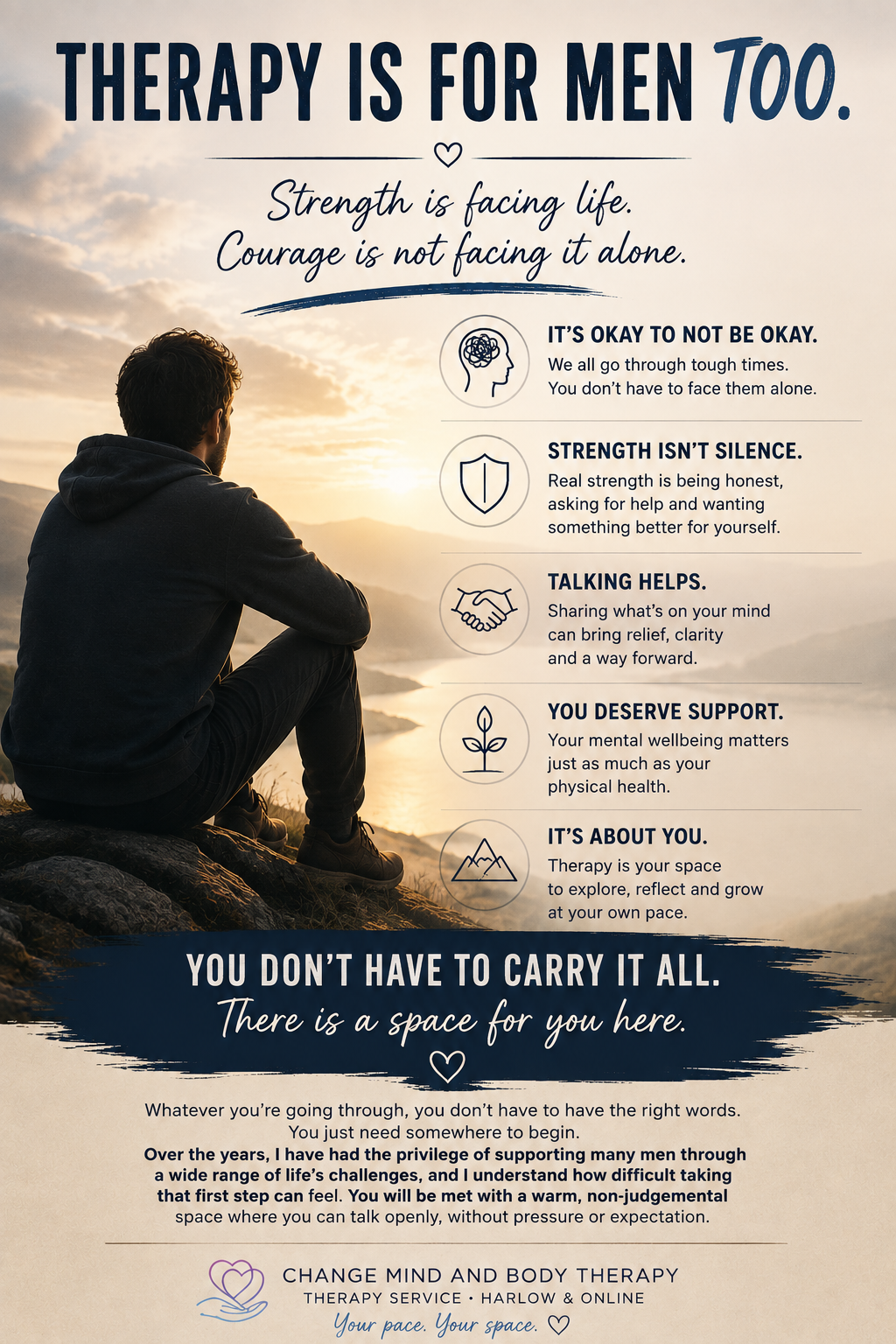
Many men grow up believing they should cope alone, stay strong, or keep their feelings to themselves. It can feel difficult to ask for help, especially when you have spent years believing you should manage everything on your own.
Therapy doesn't ask you to stop being strong; it simply offers a space where you don't have to carry everything by yourself.
You don't need to have the right words. You just need somewhere to begin.
Over the years, I have had the privilege of supporting many men through a wide range of life's challenges, and I understand how difficult taking that first step can feel. You will be met with a warm, non-judgemental space where you can talk openly, without pressure or expectation.
What you can expect in sessions
I believe therapy is a collaborative process. You bring your experiences, and I bring my training, presence and curiosity. Together, we gently explore what feels important to you.
- We move at a pace that feels safe and manageable for you.
- There is no expectation to “hold it together” or avoid emotion.
- Some sessions may focus on past experiences, others on present difficulties, coping strategies or moving forward.
- You are always welcome to bring whatever feels most present — from deeper experiences to a difficult week.
Therapy is your space, and sessions do not have to follow a strict structure. Some days you may want to explore deeper experiences from the past, while other times you may simply need space to talk about current emotions or moments of progress. All of these experiences are welcome within the therapy space.
Therapy isn’t only about talking through difficult experiences. If you’ve had a positive week, achieved something meaningful or simply want to share a moment of happiness, there is space for that too. After all, these are often the moments we are working towards. Therapy is not just about understanding the difficult times; it’s also about recognising progress, celebrating growth and making space for joy when it begins to return.